Silk Road Cultural Tour
Khiva, Bukhara, Samarkand
11-day Cultural Program (overland travel)
Artists, archeology, medieval architecture, UNESCO heritage sites, and more!
October 19-30, 2026 SOLD OUT (Waitlist started: maximum 15 participants)
November 1-12, 2026 SOLD OUT (Waitlist started: maximum 15 participants)
October 18-29, 2027 Registration open
Please join us on our cultural program through the steppes of central Asia, retracing the ancient Silk Road!
This tour is designed for those that enjoy history, natural beauty, culture & civilization, local cuisines, traditional music and arts, visiting UNESCO World Heritage sites, and learning about and exploring new places.
Highlights (UNESCO World Heritage Sites):
- Khiva: bustling marketplaces inside Ichan Kala fortress
- Bukhara: Ismail Samani Mausoleum, Kalyan Minaret, and Lyabi-Hauz plaza
- Samarkand: Registan Square, Bibi-Khanum Mosque, Gur-Emir Mausoleum, Shah-i-Zinda necropolis, and the ancient ruins of Afrasiyab
For new visitors to our company, please see our review page to get a sense of why our small group tours are so popular!
Details:
- Arrive/Depart: Tashkent, Uzbekistan (airport designation TAS).
- Transport: Internal flight, private coach, first-class high-speed train
- 11-day overland travel itinerary (11 nights).
- Visas: US, EU, or AUS passport holders do not need a visa for Uzbekistan. For other nationalities, check the country listings.
- Maximum 15 guests (only a deposit secures a place on tour).
Tour Leaders:
- Sergei Gnezdilov
- Invited specialists and guest musicians
Accommodation:
- High quality boutique hotels
Brochure:
- Contact us for the invitational tour brochure and registration form. Email: admin@johngrahamtours.com
Registration:
- Submit registration form (sent at your request)
- Send deposit of $1500 to secure your place (details in registration form)
Our Tour route:
Fees:
- Details in the tour brochure. Please email us for a copy!
- $300 discount for this tour if you have been on a previous JohnGrahamTour!
Payment Methods:
- Bank transfer (preferred)
- Personal check mailed to Vermont address
- Zelle to Vermont bank
- Credit card via Paypal (3% Paypal charge applies)
Pre/Post-Tour Options
- While we are not offering extension trips ourselves, we have recommendations!
Included:
- Accommodation in high quality boutique hotels specially vetted for comfort and location
- All ground transportation including airport transfers
- Flight: internal 90-minute flight from Tashkent to Urgench-Khiva
- High speed train, first class tickets
- All meals with delicious as described in itinerary (excludes 2 dinners at leisure, as indicated in the itinerary)
- All entrances
- Guides
- Entertainment (traditional performers)
- Special access events: meet our colorful friends!
- Water and snacks on the bus (we pamper our guests!)
Not Included:
- International airfare
- Tips for primary guides and driver
- Personal services (laundry)
- Travel insurance (required)
Mobility-Fitness:
- Standard: 5/10 on the mobility scale (10 being the most demanding). Lots of walking at sites and around towns. This is mostly flat terrain, but we will be covering distances up to 3 miles.
- For some locations, we may need to wheel suitcases 100 yards to the hotel among narrow streets where the bus cannot access. Pack accordingly.
- General fitness required. There are stairs to the sites, and sometimes long distances to cover on foot. Walks are on uneven rocky terrain, sturdy footwear required.
Special Notes:
- Prime location boutique hotels on this itinerary, historic buildings!
- Lots of arts and crafts and music on this itinerary.
- History - Architecture focus on this tour.
Weather:
- October-November weather in Uzbekistan is pleasant, dry, and sometimes cool in the evenings. In the higher elevation Samarkand, we may expect cool evenings (45 F), while day time temperatures should be in the 60s-70s F.
Travel Program…
The allure of the Silk Road cities has been growing in recent years with the popularity of books such Bergreen’s Marco Polo and Frankopan’s Silk Road, and others. Tashkent has rapidly modernization into a global capital city, impressing visitors and opening up to international travelers and expatriate residents. The vague stereotypes of Uzbekistan as a land of environmental disaster (the Aral Sea), and challenges like corruption and poverty after the collapse of the Soviet Union are being replaced with cultural revival, 21st century modernization, and potential investment destination. Among the success stories is the revival of traditional art forms such as the shashmaqom, an elaborate court music featuring virtuosic instrumentalists, vocal compositions with lyrics from sufi poetry, and complex modal scales which thrived in places like Bukhara.
The main cities of the Uzbek Silk Road (Khiva, Bukhara, Samarkand) present a fascinating and complex palimpsest of historical and cultural layering. These cities were centers of learning for Zoroastrianism, Buddhism, Nestorian Christianity, Judaism, and Manichaeism which is perhaps the quintessential “Silk Road Religion.” The 3rd century prophet Mani was called both an apostle of Christ, and a disciple of Buddha, carrying forward religious movements from east and west along the Silk Road. Since the 8th century, various Islamic kingdoms have risen and fallen along the Silk Road, leaving the impressive architecture that we will see on our tour. Jalaluddin Rumi, perhaps Sufism’s most well-known poet, traveled with his family along the Silk Road from what is now Tajikistan to central Turkey.
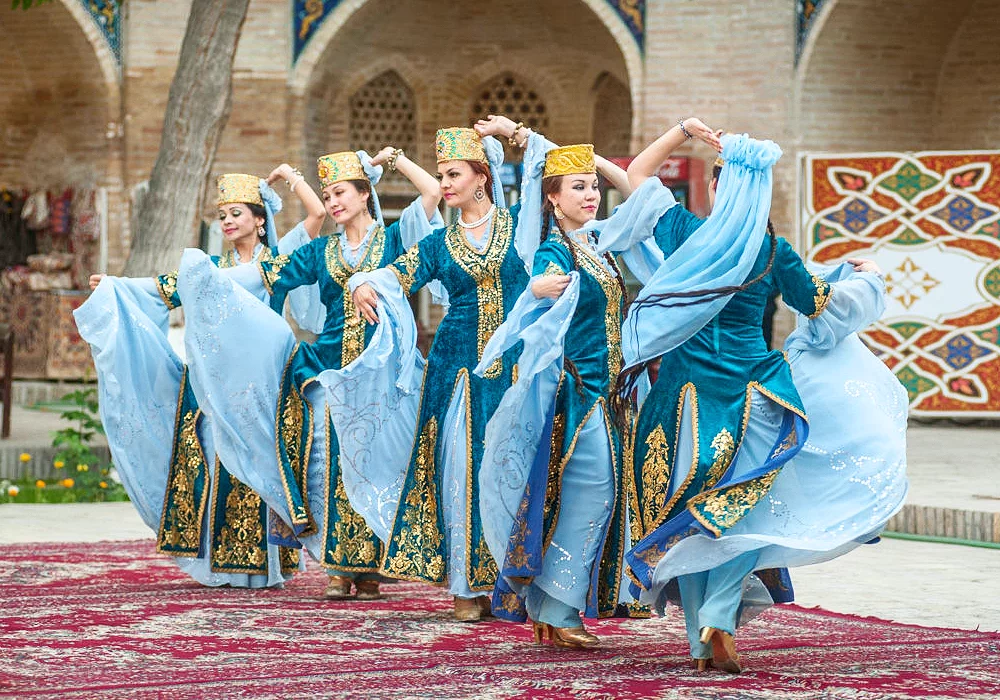
On our tour, we spend time visiting the major historical sites, but we also aim to make space for visiting artist’s workshops, see performances of local music and dance, partake in learning the specific spices and culinary practices, and learning how each community endures and thrives in modern times.
The tour starts in Tashkent, the modern capital of Uzbekistan with a population of some 3 million. The first day is relaxed as guests acclimatize to the time zone, with a program featuring “most beautiful subway in the world” as we travel to various museums. In the evening we plan a private concert of shashmaqom. On Day 3, after a 90-minute morning flight to Urgench, the group transfers by bus to the fortress city of Khiva.
Over the following days, travel will be overland via comfortable high-speed train, as the group travels to Bukhara and then Samarkand, following in the footsteps of Marco Polo and countless other travelers. It is important to pack only as much as one is willing to handle oneself, as the group will need to navigate train stations. In each city, our boutique accommodation is located within walking distance of the important historic zones, making our multi-day exploration easily accessible. Finally, the group returns to Tashkent for the final dinner to complete the tour. Read the detailed description of planned site visits below.
Over the millennia, the Silk Road has called travelers to its bazaars, its houses of worship, its oases of culture and hospitality. Even today, it beckons and invites those of us who are curious to know more, see more, and learn more. The immortal sentiment poetically framed by Mark Twain rings as true for us today as it did for the ancient traders of the Silk Road: “Travel is fatal to prejudice, bigotry, and narrow-mindedness, and many of our people need it sorely on these accounts.”
Travel opens minds to new people and new experiences, and re-energizes our attempts to create a better world everywhere. We might well be reminded of Maya Angelou’s suggestion: “Perhaps travel cannot prevent bigotry, but by demonstrating that all peoples cry, laugh, eat, worry, and die, it can introduce the idea that if we try and understand each other, we may even become friends.”
In the spirit of travel for knowledge and of kindling camaraderie among fellow seekers, we look forward to welcoming small groups of explorers for the Silk Road cultural tours this year.
Request the full brochure! Email: admin@johngrahamtours.com
ITINERARY
Days 1–2: Tashkent (2 Nights)
Modern Capital with Ancient Roots
Welcome to Tashkent, a city whose 2,000-year history stretches from ancient caravan crossroads to Soviet reconstruction and modern nationhood. Guests will be met at the airport by our chauffeur and transported to the hotel (staying 2 nights). We start the tour with a welcome dinner on October 19th, extra nights at the group hotel can be arranged for those arriving early. For our first day in the city, we’ll visit these sites.
Khast Imam Complex
The spiritual heart of Tashkent, this complex grew around the tomb of the 10th-century scholar Kaffal Shashi. Its present ensemble largely dates to the 16th century under the Shaybanid rulers. The complex houses one of Islam’s most revered relics — the 7th-century Uthman Quran — linking Uzbekistan directly to the earliest period of Islamic history. The surrounding madrassahs and mosques reflect centuries of religious scholarship in Central Asia.
Chorsu Bazaar
Located at the crossroads of the old city, Chorsu has functioned as a trading hub for centuries. Beneath its distinctive Soviet-era blue dome, merchants continue traditions that began when Silk Road caravans passed through ancient Chach. The market remains a living continuation of Central Asia’s mercantile heritage.
Tashkent Metro
Opened in 1977, the metro is one of the most architecturally ambitious in the former Soviet Union. Each station was designed as a monumental “palace for the people,” blending Soviet symbolism with Uzbek decorative motifs — an artistic response to the 1966 earthquake that reshaped the city.
Museum of Applied Arts
Housed in a former diplomat’s mansion, the museum preserves centuries-old traditions of ceramic art, suzani embroidery, wood carving, and metalwork — crafts that once traveled the Silk Road and helped define Central Asia’s artistic identity.
Private Concert
We are planning a private concert with dinner featuring shashmaqom, a refined sort of music, with lyrics derived from Sufi poems about divine love. The instruments of shashmaqоm consist of a pair of long-necked lutes (rawap, tar, tanbur or dutar), the dayra (frame drum), and the sato (bowed lute).
Days 3–4: Khiva (2 Nights)
A Perfectly Preserved Silk Road Citadel
We take a 90-minute flight from Tashkent to Urgench. From there we take a private minibus to visit some of the desert fortresses in the Ellik Qala complex. By evening, we arrive within the mighty walls of Khiva, a UNESCO World Heritage site and one of the most intact medieval cities in the Islamic world. Check in to hotel (staying 2 nights). Over the following day and a half, we visit the following:
Itchan Kala
Encircled by massive mud-brick walls dating largely from the 17th century, Itchan Kala contains more than 50 historic monuments. Though many structures are from the 18th–19th centuries, the city’s foundations stretch back over a millennium. It flourished as the capital of the Khiva Khanate, strategically positioned between Persia, Russia, and nomadic territories.
Kalta Minor Minaret
Begun in 1851 by Khan Muhammad Amin, this striking turquoise-tiled tower was intended to be the tallest minaret in Central Asia. Construction halted upon the Khan’s death, leaving it uniquely squat and broad — yet one of the most iconic silhouettes of the Silk Road.
Tosh-Hovli Palace
Built in the 1830s as the residence of Allakuli Khan, the palace showcases elaborate carved wooden columns and vibrant Khorezm tilework. Its harem courtyards and audience halls reflect the ceremonial power of the khans during Khiva’s political zenith.
Juma Mosque
Unlike typical Islamic mosques crowned by domes, the 10th-century Juma Mosque (rebuilt in the 18th century) is famed for its forest of over 200 carved wooden columns. Some columns date back nearly a thousand years, preserving layers of artistic evolution.
Days 5–7: Bukhara (3 Nights)
The Sacred and Scholarly Heart of Central Asia
Few cities rival the historical depth of Bukhara, a major intellectual center of the Islamic Golden Age, and famous for one of the longest-enduring Jewish communities. We travel from Khiva to Bukhara on day 5 (6 hours), and check in to the hotel (staying 3 nights). Over the following days, we will visit these sites, and meet local artists and musicians.
Po-i-Kalyan Complex
This monumental ensemble anchors Bukhara’s skyline. The Kalyan Minaret, built in 1127 by the Karakhanids, survived Genghis Khan’s invasion and once served as both a call to prayer tower and symbol of political authority. The adjacent mosque and Mir-i-Arab Madrassah reflect the city’s status as a theological powerhouse.
Ark Fortress
Dating in origin to at least the 5th century CE, the Ark functioned as the seat of Bukhara’s rulers for over a millennium. Rebuilt repeatedly after invasions, it housed royal courts, treasuries, and prisons. It remained the residence of the Emir until the Russian conquest in 1920.
Trading Domes
The 16th-century domed bazaars — Toki Zargaron, Toki Telpak Furushon, and others — were purpose-built commercial centers where jewelers, hat makers, and money changers operated under vaulted ceilings designed to cool desert heat. They reflect Bukhara’s prosperity as a Silk Road mercantile hub.
Lyabi-Hauz Ensemble
Centered around a tranquil pool built in 1620, this plaza is framed by madrassahs and a khanqah (Sufi lodge). In a desert climate where water symbolized life and blessing, such pools were vital community gathering spaces.
Days 8–10: Samarkand (3 Nights)
Imperial Capital of Timur
The ancient city of Samarkand has been a regional capital city for several millenia. We travel from Bukhara to Samarkand by high-speed train (3 hours) and check-in to hotel (staying 3 nights). Over the following days, we will explore this legendary city on foot, including these highlights:
Registan Square
The ceremonial heart of Timurid Samarkand, Registan evolved over two centuries. The Ulugh Beg Madrassah (1417–1420) reflects the ruler’s passion for astronomy and science, while the later Sher-Dor and Tilla-Kari madrassahs complete the harmonious square. Its monumental scale symbolized imperial ambition.
Shah-i-Zinda
This sacred necropolis developed between the 11th and 15th centuries around the legendary tomb of Qusam ibn Abbas, a cousin of the Prophet Muhammad. The dazzling tilework adorning its mausoleums represents some of the finest ceramic artistry of the Timurid era.
Bibi-Khanym Mosque
Commissioned by Timur after his Indian campaign in 1399, this colossal mosque was intended to be the grandest in the Islamic world. Though partially damaged by earthquakes, its scale and ambition reflect Timur’s desire to rival the greatest capitals of his time.
Gur-e-Amir Mausoleum
Originally built for Timur’s grandson, the mausoleum became Timur’s own resting place in 1405. Its ribbed azure dome and intricate interior influenced later Mughal architecture, including monuments in India.
Days 11–12: Return to Tashkent
On our final day, we travel by high-speed train 3 hours back to Tashkent. Over a celebratory banquet, we’ll reflect on the highlights of our journey that has spanned more than two millennia of history — from ancient caravan cities and Mongol conquests to Timurid splendor and modern independence.
Check in to hotel (staying 1 night). Airport transfers as necessary.
Request the full brochure! Email: admin@johngrahamtours.com


